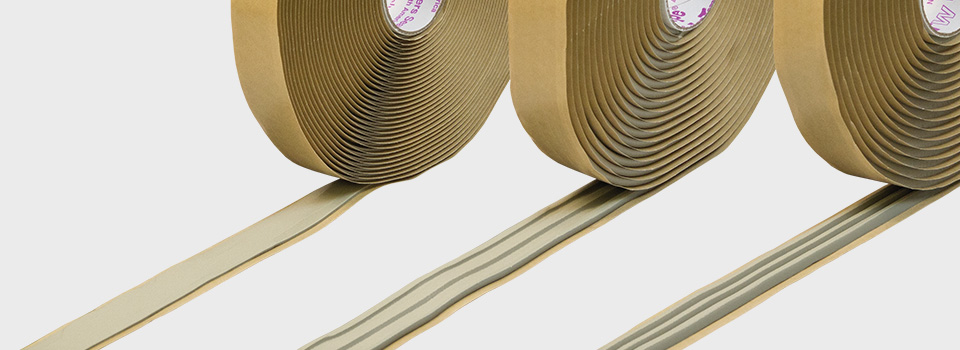
Tacky Tape® SM5227 is a highly elastic butyl tape with excellent surface tack specifically designed for sealing metal roof panel joints and Standing Seam Roof (SSR) endlaps. Its superior surface tack allows it to adhere to metal substrates that are contaminated with light roll forming oil without prewiping the surface. It has excellent adhesion and compressibility to cold substrates. It is formulated without asbestos fillers.
[mvc_advanced_button align=”center” padding_top=”15″ padding_left=”30″ btn_url=”url:https%3A%2F%2Ftacky-tape.com%2Fwp-content%2Fuploads%2Fbsk-pdf-manager%2F92_TACKY_TAPE_SM5227_TDS_02-16-15.PDF|title:SM5527%20Data%20Sheet|target:%20_blank|” btn_text=”Download Brochure” btn_clr=”#ffffff” btn_bg=”#828282″ btn_hvrclr=”#ffffff” btn_hvrbg=”#0c0c0c” caption_url=””]


PRODUCT DETAILS
Tacky Tape® SM5227 is 100% solids, asbestos-free butyl tape sealant that is a highly rubbery, tacky, reinforced compound designed for sealing metal lap joints in the metal building industry. It is easy to apply and compress during installation. It exhibits excellent application and performance characteristics over a wide temperature range and will not become brittle, crack or flow during service. It is available in various sizes supplied in ready-to-use rolls and pre-cut end lap pads for standing seam roof (SSR) applications. It is also available in double and triple bead rolls and end lap pads.
Tacky Tape® is designed to seal and prevent the entry of dust, air
and moisture and assure a weather tight seal in metal building
details.
-
Metal rib and end joints
-
Standing seam roof end laps
-
Sealing roof curbs roof jacks and skylights
-
Sealing polyethylene sheeting
-
Sealing air conditioning equipment
-
Window and door flanges
-
Sub sill air and water seal between Wood & Concrete.
-
Excellent adhesion to oily GALVALUME®, GALVALUME PLUS®, ACRYLUME®, ZINCALUME®, Kynar 500®, aluminum, aluminized steel, polyvinyl fluoride and siliconized polyester painted metal, concrete, FRP and glass
-
No cracking or loss of adhesion at -40°F
-
Service Temperature Range -40°F to 200°F
-
Application Temperature Range -5°F to 120°F
-
Elongation (ASTM C908) > 1000%
-
Adhesive Tensile Strength (ASTM C907) 20 psi minimum
-
Will resist fungal attack and not support mildew growth
-
Meets AAMA 804-92 and 807-92 (this specification supersedes obsolete NAAMM Standard SS-1B-68)
-
Meets ASTM E1680 Air Infiltration
-
Meets ASTM E1646 Water Leakage
-
Excellent for sealing Galvalume®, Galvalume Plus®, Zincalume® and KYNAR 500®
-
Adheres to oily Galvalume®
-
Will not corrode Galvalume®, Galvalume Plus® and KYNAR 500®
-
Meets ASTM and Federal Standards
-
Non-staining
-
Permanently flexible
-
Resistant to ultraviolet and infrared radiations, precipitation, atmospheric hydrocarbon contamination and extremes in temperature
-
AAMA 804.3
-
AAMA 807.3
-
Federal Specification TT-C-1796A, Type II, Class B
-
USDA acceptable
-
UL Approval for sizes up to and including 3/4″ width x 1/4″ thick
How To Install
Tacky Tape requires no tools for installation. It comes in an easy-to-handle roll and the adhesive is quickly exposed with a simple peel-back.
Optimally, a clean dry uncontaminated surface is desired to obtain intimate adhesion, but realistically there are field situations that prevent complete control of surface conditions.
Obviously, excessive oil, caked-on dirt, free standing water and ice or snow must be removed before sealant tape is applied.
This sealant tape can be applied in cold temperatures. Temperatures below 40°F (4.44°C) often promote the formation of condensation and frost substrates. These should be removed
before the sealant tape is applied in order to achieve optimum performance. Remove condensation and other moisture with a clean dry cloth and isopropyl (IPA) alcohol. Follow this with a dry cloth wipe.
A light film of lubricant used in roll forming is usually present on unpainted surfaces, such as Galvalume and should not adversely affect the sealant tape performance. If excess lubricant is
present wiping with a clean cloth should minimize it.
Position tape sealant on required seal area with release backing paper on top. The tape sealant should be positioned on the “wet”, or entry sides of the fasteners to prevent passage of dynamic weather elements. Using a smooth even hand motion; press the tape to the surface to make intimate contact without distorting the tape sealant. Avoid lapping the tape by butt joining tapes at transition points. Remove release-backing paper prior to mating adjoining surface and fastening. IF SEALANT TAPE IS IN DIRECT CONTACT WITH ANY OTHER SEALANT OR ELASTOMER, A COMPATIBILITY TEST MUST BE CONDUCTED PRIOR TO USE.
[/accordion_son][/accordion_father][mvc_advanced_button align=”center” padding_top=”15″ padding_left=”30″ btn_size=”22″ btn_text=”Product Questions?” btn_url=”url:https%3A%2F%2Fwww.osidistribution.ca%2Fcontact-osi%2F|title:Contact%20OSI%20Distribution||” btn_clr=”#ffffff” btn_bg=”#dd3333″ btn_hvrclr=”#ffffff” btn_hvrbg=”#878787″]
MORE ITW PRODUCTS